Easy, quick and precise way of measuring PCBA clock signal
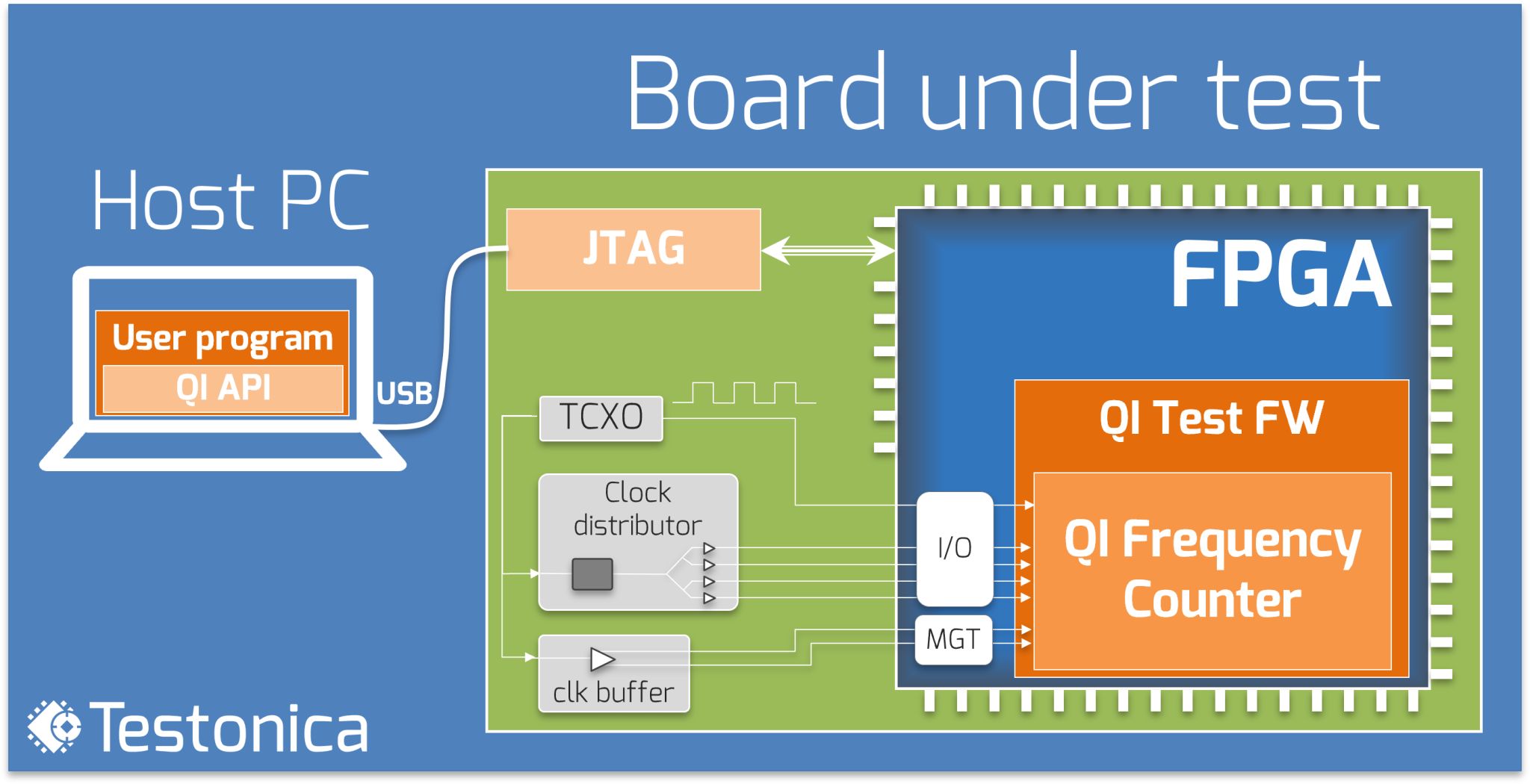
One of the most commonly measured signals on a PCBA is a clock signal. QI Frequency Counter provides a non-invasive way to precisely measure the frequency of on-board clock signal lines and check whether the frequency is within the specification range. The measurement takes only several seconds and fits for the production in-line test. No need to use probes, external equipment, and fixture cables as all measurements are done inside your product.
Clock oscillators and PLLs are traditionally used to provide a stable free-running clock signal for FPGA design. The integrity of clock signals is important to guarantee system correct functionality. Instability or wrong frequency leads to unexpected and non-deterministic behavior of the whole system, especially when it is used in high-speed synchronous interfaces.
Target clock signals are both single-ended (LVCMOS, LVTTL, etc.) and differential ones (LVDS, PCML, HCSL, etc.) coming either to normal I/O pins or MGT blocks of FPGAs.
BTW! Using QI API, frequency measurement can be done in just one line of code:
Freq.Measure("IC1.IO_E3", out value); //FPGA pin, measured value in Hz
See more details here.